How to Prove a Photo Is Not AI Generated
Flagged by an AI detector? Six pieces of evidence prove your photo is real, from the original file and its camera data to Content Credentials.
 Noman Mustafa Owner
- Published
- Updated
- Reading time8 min
On this page 15 sections
A tool said your real photo was made by AI. Now you need to prove your photo is not AI, with evidence rather than an argument.
This guide gives you six pieces of evidence, strongest first. You can gather most of them in ten minutes. Start with a free check on the Convertavo AI image detector, which takes 2 to 4 seconds and shows you what it found.
How to prove a photo is not AI generated
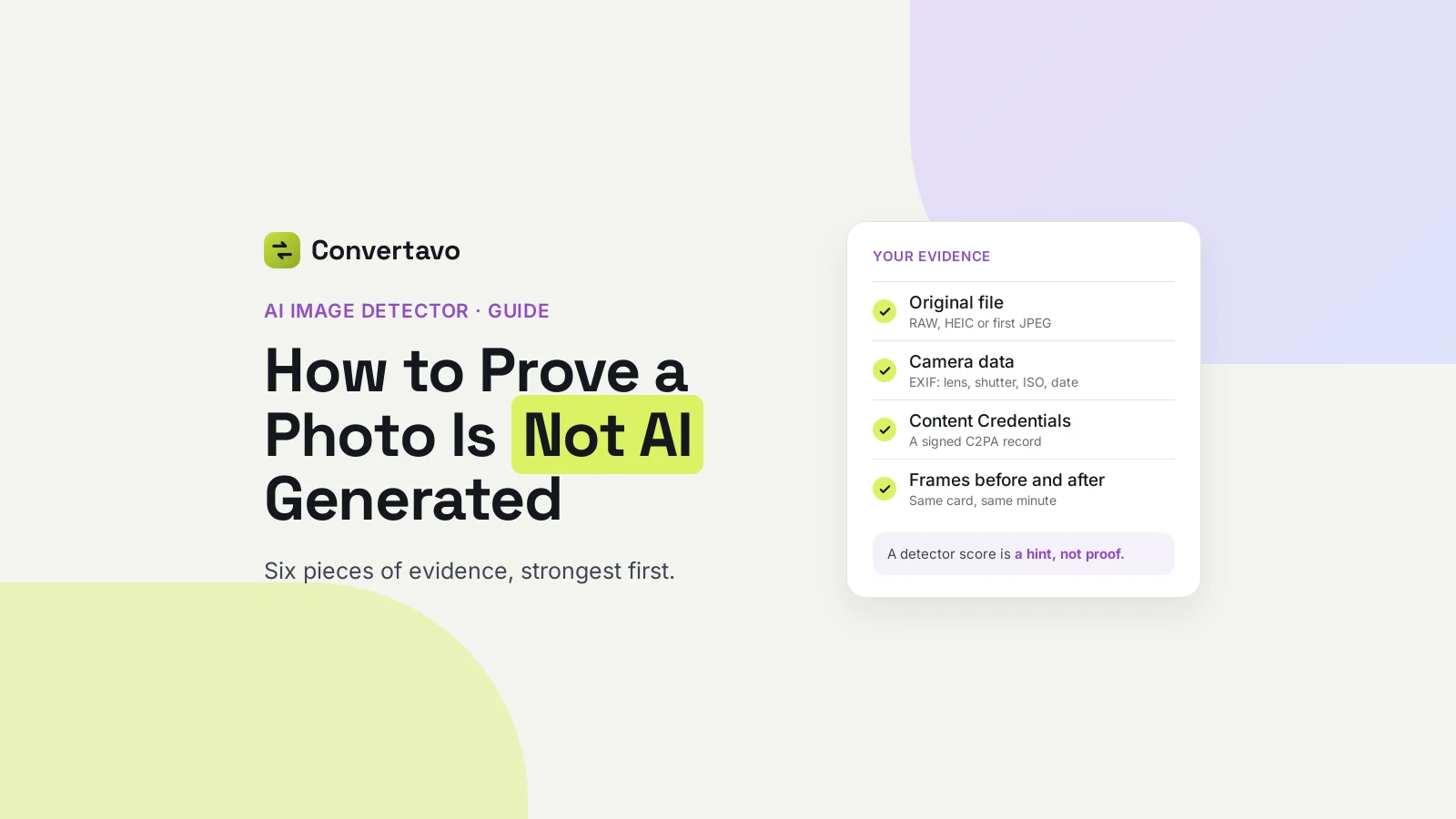
Collect six things, in this order. The first three take about ten minutes.
Check the image yourself first. Open the AI image detector, drop in a JPG, PNG or WebP up to 8 MB, and press Check image. You get a verdict, a confidence number and the evidence behind it in 2 to 4 seconds. If it also reads your photo as real, say so and name the tool.
Find the original file. That is the RAW, the HEIC, or the first JPEG that came off the camera. Never send the copy you downloaded from WhatsApp or Instagram. Those copies are resized and squeezed, and that is what makes detectors nervous.
Show the camera data inside the file. Right click the file, open Properties or Get Info, and look at Details. Camera make, lens, shutter speed, ISO and the date should be there. AI generators do not write any of that.
Look for Content Credentials. Some cameras and editors sign a file with a record of how it was made. You can check a file for free at contentcredentials.org. A signed record beats any score a detector gives you.
Show the frames around the shot. Send the two or three pictures you took before and after. Same card, same minute, same place. Big contests like World Press Photo ask for exactly this, because nobody generates a whole burst by accident.
Run a reverse image search. If your picture is already online from before AI image generators existed, the argument is over. Google Images, TinEye and Bing all do this free.
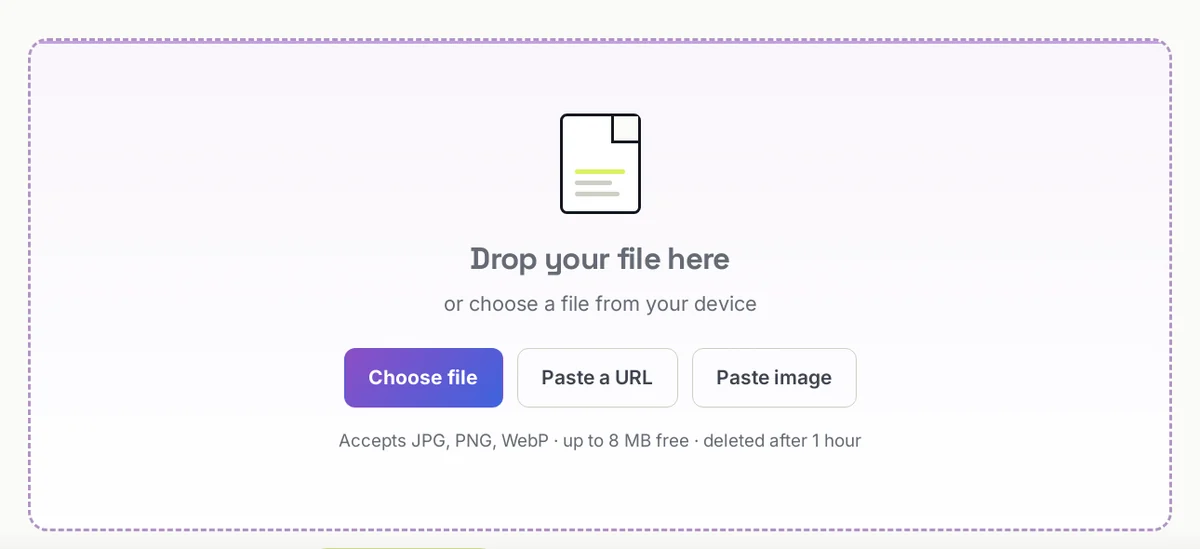
Step 1: drop the photo in and press Check image.
If you only have time for two, do step 2 and step 3. The original file with its camera data is the strongest everyday proof.
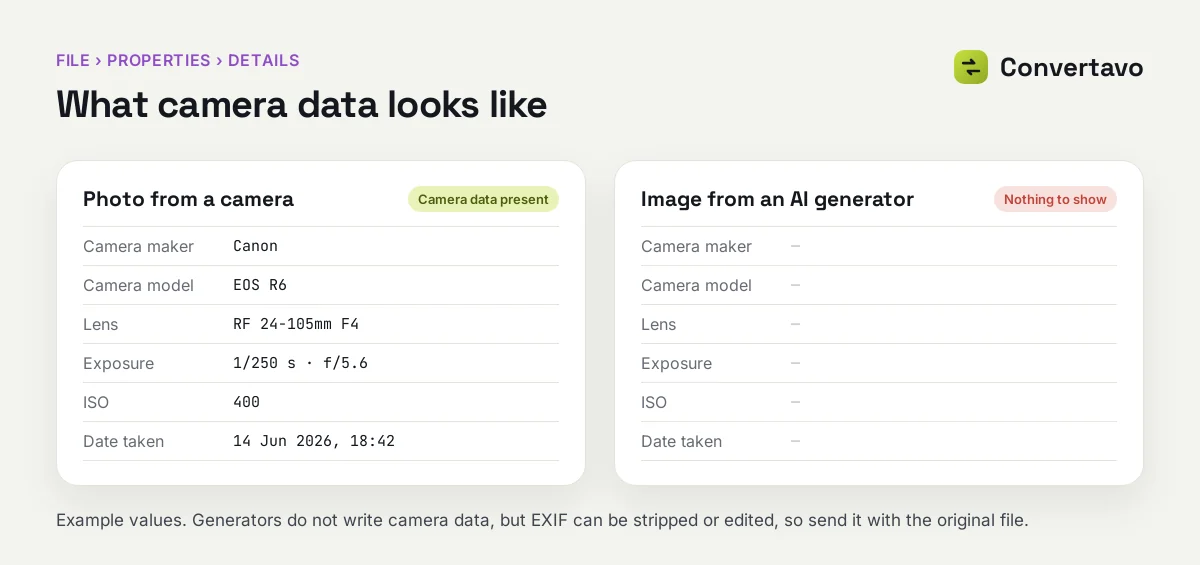
What step 3 looks like. The values on the left are an example.
Which proof is strongest?
The file itself is the best witness, and a detector score is the worst one. A detector only reads patterns in the pixels and guesses. Your original file carries facts that are hard to invent.
Here is every kind of proof, ranked.
Proof | What it shows | How strong |
|---|---|---|
RAW or the original camera file | Full sensor data, no re-saving | Strongest |
Content Credentials (C2PA) | A signed record of how the file was made | Very strong, when it is there |
Frames shot before and after | A real session, not one lucky file | Very strong |
EXIF camera data | Camera, lens, shutter, ISO, date, sometimes GPS | Strong, but it can be stripped or edited |
Reverse image search hit from before 2022 | The picture existed before these generators did | Strong |
A second detector that says "real" | One more opinion | Weak on its own |
A single detector score | A statistical guess about the pixels | Weakest |
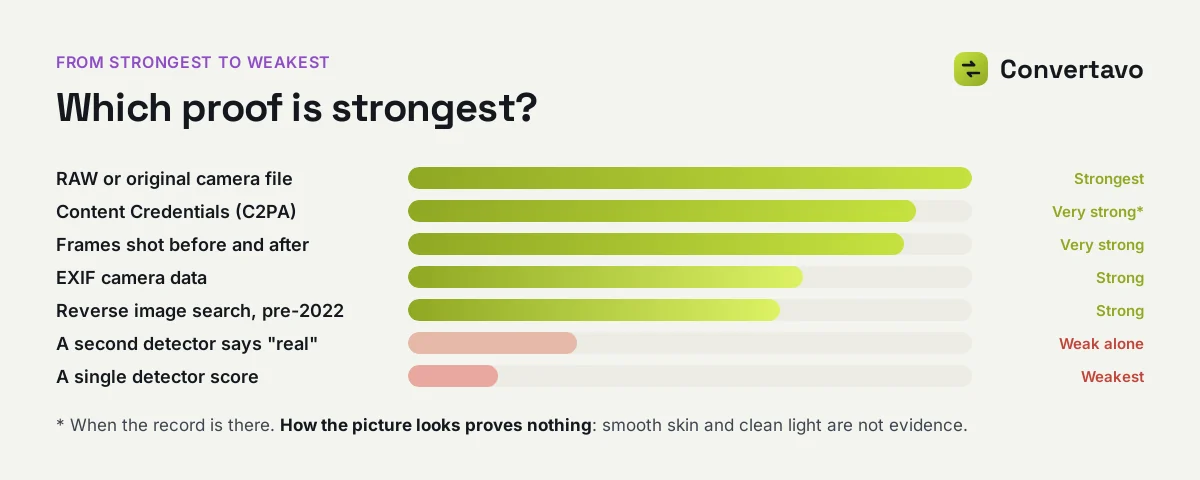
The original file wins. A lone detector score comes last.
Notice what is missing from that list: how the picture looks. Smooth skin, clean light and sharp eyes prove nothing. People have lost contests over exactly that kind of guesswork.
What to send, based on who accused you
The proof is the same. What changes is how much of it you send, and how fast.
A photo contest disqualified your entry
Ask two questions in writing. Which tool was used, and what score did it give? Then send the RAW file, the frames around it, and the camera data. This is already the standard at serious contests, so the request will not surprise anyone.
Someone says your artwork is AI
Art is the hardest case, because paintings and 3D renders never looked like camera photos anyway. Send your layer files, sketches, or a screen recording of you working. A time lapse ends most arguments in one minute. For digital drawings, run them through the AI Art Detector first, so you know what a checker will see.
A marketplace or client says your product photo is fake
Send the original off the camera plus one extra shot of the same item from another angle. Keep the raw shots from every shoot in a dated folder. Sellers who do this settle these disputes in a day.
A platform removed your post as AI
Appeal with the original file attached, not a screenshot of it. A screenshot throws away every piece of evidence you have. If your photo is an iPhone HEIC file and the form will not accept it, convert it first with HEIC to JPG, and keep the HEIC.
Is the check free, and is my photo safe?
Yes to both, and here are the exact numbers.
Free. You get 20 credits a day and each image check costs 10. That is two free checks a day, with no email address and no watermark. A free account raises it to 50 credits a day, which is five checks, and new accounts start with 100 bonus credits.
Limits. JPG, PNG and WebP, up to 8 MB. A check normally finishes in 2 to 4 seconds on the free queue.
Private. The check runs on Convertavo's own server. Your image is never passed to an AI company, and the upload is deleted one hour after it is processed.
That last point matters more than people think. If you are trying to prove a private photo is not AI, you should not have to hand it to a company that trains image models.
How often do AI detectors get real photos wrong?
Often enough that one score should never end an argument. In a May 2026 audit, NewsGuard ran 15 genuine news photographs through five well known detectors. The tools called those real photos AI generated 13.3% of the time. The worst one got six of the 15 wrong, a rate of 40%, while two of the five made no mistakes at all.
So the same picture can be "real" on one site and "AI" on the next. That is the number to quote when somebody waves a score at you.
The reasons are boring, and that is the problem. ZeroGPT's chief executive told NewsGuard that simple resizing and compression can make a real photo read as AI. Those two things happen to every image you upload anywhere.
Convertavo publishes its own number for the same reason. On its labelled test set the model was right about three times in four. That is useful, and it is not proof.
What each kind of check can and cannot say
Check | What it can find | What it cannot say |
|---|---|---|
Pixel detector | Patterns that usually appear in generated images | Which generator made it, or that a photo is definitely real |
Content Credentials (C2PA) | A signed record of the camera, the tool and the edits | Anything at all once the record has been stripped |
SynthID watermark | A hidden mark from Google and its partners | Anything about images from makers outside that group |
Two rules almost nobody writes down
No credential is not the same as fake. The C2PA standard says plainly that missing credentials prove nothing either way. Most social networks strip them on upload, so almost every shared photo arrives bare.
No watermark is not the same as real. Google's SynthID Detector is now open to everyone, and it checks images, video and audio from Google, OpenAI, NVIDIA and other partners. It only sees watermarks from those makers. A blank result tells you nothing about an image from anywhere else.
Learn those two lines and you are already ahead of most people judging your photo.
Why does a detector say my real photo is AI?
Usually because something smoothed the picture before the detector saw it. Find your case in the table and send the fix with your reply.
What happened to the photo | Why it confuses a detector | What to do |
|---|---|---|
Beauty filter or heavy retouching | Skin and texture get smoothed the way generators smooth them | Send the untouched original |
AI upscaling or strong noise reduction | The software invents detail that was never in the frame | Send the file from before the upscale |
Night mode or portrait mode | The phone already builds that picture from several frames | Send it with the EXIF data showing |
Downloaded from WhatsApp or Instagram | It was resized and squeezed, and the metadata is gone | Send the copy from your own camera roll |
A screenshot of the photo | A screenshot throws away every original clue | Never submit screenshots as evidence |
Very small or low resolution file | Too few pixels for the model to judge | Send the full size file |
A scan of film | Grain plus scanner sharpening looks unusual | Show the negative or the contact sheet |
A digital painting or 3D render | These models mostly learned from camera photos | Show layers, sketches or a time lapse |
Before you panic, read the confidence number. Anything below about 65% is close to a coin toss, and a good report will label it as low confidence.
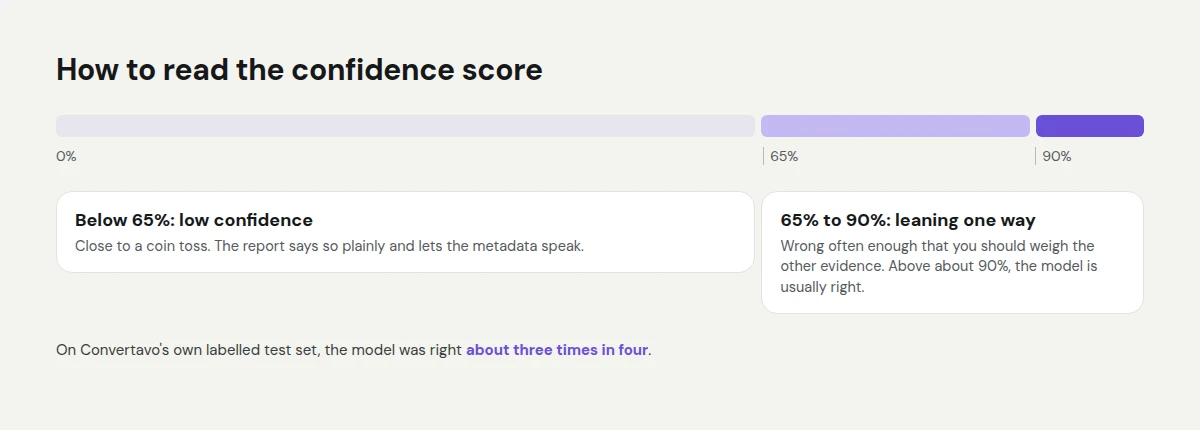
Below about 65%, the report is telling you it cannot tell.
Other free tools that help with this
AI Art Detector runs the same two checks, with guidance written for drawings and paintings.
Image to Text pulls the words out of a screenshot, so you can quote a flag message exactly.
Compress Image brings a file under 8 MB when a form refuses it, after you have kept the original.
Check your photo before someone else does
Keep your originals, keep the frames around them, and know your own file before anyone questions it. That is the whole defence, and it takes one minute per picture. Run yours through the free AI image detector and read what the report actually says.
Sources
AI detectors keep calling real photos fake, PhotoWorkout, 20 June 2026, reporting NewsGuard's May 2026 audit of five detectors.
SynthID, Google DeepMind, on SynthID Detector being open to everyone and its partner list.
Frequently asked questions
Can you really prove a photo is not AI generated?
Yes, in practice, though not with a single click. The original file, its camera data and the frames around it convince almost anyone. A detector score alone convinces no one.
Does EXIF data prove a photo is real?
It is strong evidence, not proof. Camera make, lens, shutter speed and date are things AI generators do not write. Someone can edit EXIF by hand, so pair it with the original file.
Are AI image detectors accurate?
Not accurate enough to accuse anyone. Independent testing in May 2026 found five leading tools calling real news photos AI generated 13.3% of the time. Treat any score as a hint.
What should I send if a contest says my entry is AI?
Send the RAW or original file, two or three frames from the same session, and the camera data. Ask which tool flagged you and what score it gave.
Can I use a screenshot of my photo as proof?
No. A screenshot has no camera data, no Content Credentials and fresh compression. It removes the exact evidence you need.
Can someone fake camera data?
Yes, EXIF fields can be edited, which is why no single piece of evidence stands alone. Two or three kinds of proof together are very hard to fake.
My photo has no Content Credentials. Is that bad?
No. The C2PA standard says missing credentials mean nothing either way. Most platforms remove them when you upload.
Try it on your own file
Free, no signup, and your file is deleted an hour later.
Noman Mustafa — Founder of Convertavo I build the file tools on this site. Fifteen years of writing software, and most of my days now go into making PDF, image and OCR processing fast enough to run in a browser tab. I write here about what I learn breaking files apart.